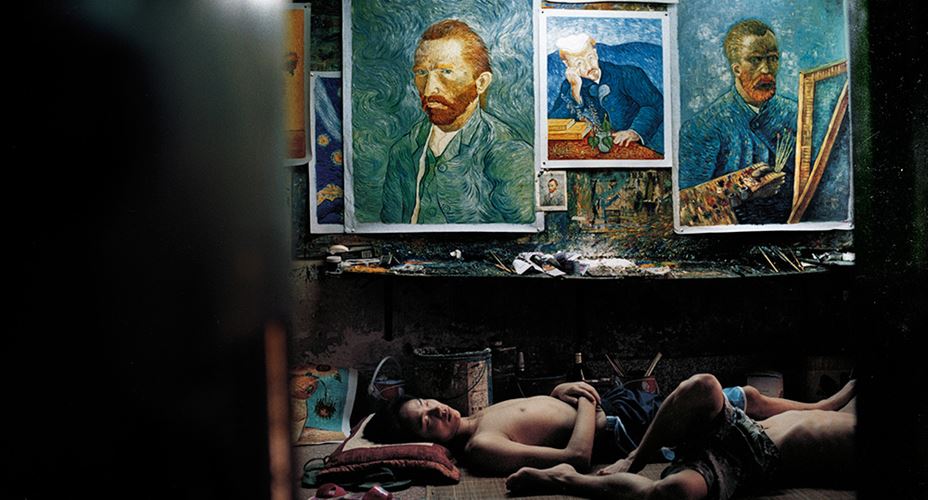
Imagine you are standing in a dingy souvenir shop in Amsterdam, browsing the handmade oil painting replicas of van Gogh’s masterpieces. Out of curiosity you ask the store employee where they are made, to which they reply gingerly, “in China”.
The omnipresent tag ‘made in China’ springs to mind, bearing connotations of cheap labour and mass production. The revelation of Chinese manufactured copies could not feel any further in sentiment to the isolated existence of van Gogh and the tragic events that fuelled his drive to create. So it seemed… Haibo Yu and Kiki Tianqi Yu’s documentary serves to shed light on those far away manufacturers and reshape our understanding of ‘made in China’.
Towards the end of the film, one man’s epiphany raises important questions to be debated: is China ready to become a trailblazer in regard to the advancement of certain global creative industries? Or is it going to play it safe and focus on the continuation of their tried and tested methods of economic prowess; the mass production and manufacture of goods we all know and love. Or why not both?
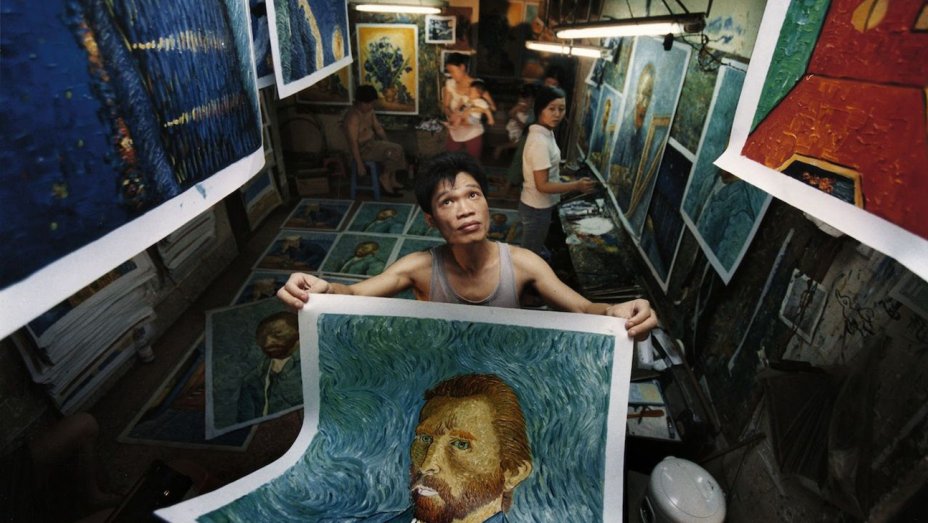
The documentary follows the family business of Zhao Xiaoyong in Dafen, a small painter’s village in Shenzhen. Dafen is known for churning out handmade replica artworks of well-known European masters such as De Vinci, van Gogh, Titian, Rembrant, Turner and so on. Zhao’s paintings appear to be exclusively van Goghs. Unsurprisingly, his paintings sell best in Amsterdam. Tourists can see the Dutch painter’s prized works in the flesh, then head out into the street and find a Chinese replica for around €50.
Within the first half hour, it quickly dawns on you that Zhao’s relationship with van Gogh is far more than of mere financial benefit. It may have begun in that fashion, but his veneration for the Dutchman is made quite clear all throughout.
One particularly heart-warming moment is when Zhao hosts a screening of “Lust for Life” (1956) for the other painters of Dafen. The camera pans across the audience, their facial expressions disclosing their tender feelings toward Kirk Douglas’ scruffy rendition. Before the film starts, Zhao remarks to the audience “van Gogh is the most respected painter among us.” His words illustrate an intimate scenario in which van Gogh is a peer to emulate, a fellow painter and teacher to the group. In Zhao’s mind, his relationship with van Gogh is profoundly personal.
Haibo & Kiki did an incredible job at capturing Zhao at his most vulnerable. His ambitions as a painter had been influenced by the knowledge that his copies were up in a gallery in Amsterdam, but finding them strung up in a small souvenir shop during his trip to Europe left him in a directionless state of melancholy. This sombre state is reiterated in a conversation had with friends when back in Dafen, where Zhao laments over his lack of originality.
After studying and copying van Gogh’s works for nearly two decades, Zhao has become a master in his own right. This was not achieved through his ability to create a neat replica, but is owed to his fastidious devotion and admiration for the great artist. It has entirely shaped his life.
“China’s van Goghs” encourages its audience to see the tag ‘made in China’ from a fresh perspective. The Western trend of a predisposed caution relating to the quality, integrity, and sentiment of products made in the far East is unfair and perhaps, xenophobic; maybe, just maybe, there has be decades of study, toil and love invested into that Chinese made product you own.
In a conclusive act, Zhao paints scenes of home in the style of van Gogh to remedy his internal crisis. The documentation of paint worker to artist is simple, but it carries an interesting metaphor regarding the future of China’s creative sectors.
Is China ready to pave the way?
When pioneering in any creative sector on a micro or macro scale, financial risks often have to be taken. It is mystery to Zhao whether his paintings of his own environment would ever turn a profit, but he took a step into the unknown nonetheless. In a nation where mass poverty and financial ruin remain in living memory, the scars of the past century are sure to effect China’s decisions in endorsing creative ventures at the expense of capital. While the globe might not think of China as harbouring the freshest and most exciting contemporary art scene, its creativity can be found in the world of technology.
Virtual Reality (VR) is a creative market that China’s central government has invested an enormous amount of money in. We need only look to the VR Star Theme Park in Guizhou, a $1.5 billion build project set to offer some of the most immersive VR experiences globally available. China’s investment in the VR industry indicates a future of simulated entertainment accessible to the masses.
The Robotics industry is another market that China is investing in heavily. Borns Robotics is a start-up that designs and produces medical bots to carry out precise surgical operations. While the start-up owes its knowledge to tech-industries in the US, the central government investments have put Borns and other med-tech companies like it on the map, and their products will be used worldwide in the near future. China may not be ahead of the US currently in its design and manufacture of high-tech robotics, but the trajectory is looking like the switch might happen in the next decade.
Currently, it seems to me that China stands in a similar position to the film’s protagonist Zhao Xiaoyong, confident enough to pioneer and create, but all the while employing Western knowledge and inspiration of technology to perform. It is up for debate whether the contemporary art scene in China will ever rival those of Britain and the US, but the country’s creativity and innovation in manufacture and technology will undoubtably shape the future of our planet.
 Film Dialectic